
As the world accelerates towards a digital-first future, Dubai has firmly established itself as a global leader in artificial intelligence. With a staggering 97% of UAE residents already using AI-powered services and a market projected to exceed $4.3 billion in 2025, the question for businesses is no longer if they should adopt AI, but how quickly they can integrate it into their core operations. For companies in Dubai, AI integration is not just a technological upgrade; it is a strategic imperative for survival and growth.
This comprehensive guide provides a detailed roadmap for business owners, CTOs, and decision-makers on navigating the world of AI integration in Dubai. We will explore everything from the foundational concepts of AI solutions to the practical steps of implementation, including costs, ROI, and the critical compliance landscape defined by the UAE AI Strategy 2031. Whether you are a small business looking to automate processes or a large enterprise aiming for a complete digital transformation, this guide will equip you with the knowledge to harness the power of AI and secure a competitive edge in Dubai’s dynamic market.
Understanding AI Integration: What It Means for Dubai Businesses
Artificial intelligence is more than just a buzzword in Dubai; it is the engine driving the next wave of economic growth and innovation. However, to truly unlock its potential, businesses must move beyond simple AI adoption and embrace comprehensive AI integration. This means embedding intelligent systems deep within your existing processes and platforms to create a smarter, more efficient, and data-driven organization.
What is AI Integration?
AI integration is the process of incorporating artificial intelligence technologies into your existing business software, applications, and workflows. Unlike standalone AI tools that operate in isolation, integrated AI systems communicate and collaborate with your other business platforms—such as your CRM, ERP, and marketing automation software—to enhance their capabilities and automate complex tasks. For example, instead of using a separate AI chatbot for customer service, an integrated AI solution would connect that chatbot directly to your CRM to personalize conversations, update customer records, and even initiate sales workflows automatically.
Why AI Integration Matters in Dubai’s Digital Economy
Dubai’s government has laid a clear and ambitious path for an AI-powered future. The UAE AI Strategy 2031 aims to make the nation a global leader in AI, with a projected 45% contribution to the UAE’s GDP by 2031, equivalent to an economic impact of AED 335 billion. Initiatives like Smart Dubai are already transforming public services and creating a hyper-connected urban environment. For businesses, this top-down push for AI creates an ecosystem ripe with opportunity. Early adopters of AI integration will not only benefit from government support but will also be better positioned to meet the evolving expectations of customers and partners in this advanced digital landscape.
The Difference Between AI Solutions and AI Integration
While often used interchangeably, AI solutions and AI integration represent two distinct approaches to leveraging artificial intelligence. Understanding the difference is crucial for developing an effective AI strategy.
| Feature | Standalone AI Solution | Integrated AI Solution |
| Function | Performs a specific, isolated task | Enhances existing systems and workflows |
| Data Flow | Operates on its own dataset | Shares data across multiple platforms |
| Example | A simple grammar-checking tool | An AI-powered marketing platform that writes, optimizes, and schedules social media posts based on real-time analytics from your CRM |
| Business Impact | Solves a single problem | Drives comprehensive business transformation |
For most Dubai businesses, the goal should be to move from using disparate AI solutions to implementing a cohesive AI integration strategy that creates a unified, intelligent ecosystem.
The Current State of AI Adoption in Dubai and the UAE (2025)
The UAE has one of the highest AI adoption rates in the world, driven by strong government support, significant investment, and a tech-savvy population. This section explores the key statistics and trends that define the AI landscape in Dubai and the wider UAE.
Dubai AI Market Statistics and Growth Projections
The numbers speak for themselves. The UAE’s AI market is experiencing explosive growth, with various sources estimating its value between $2.20 billion and $4.3 billion in 2025. This market is projected to grow at a compound annual growth rate (CAGR) of 22-28.7% through 2030, making it one of the fastest-growing technology sectors in the region.
Key statistics include: – 97% of UAE residents are already using AI in their daily lives. – 52% of firms in the Dubai International Financial Centre (DIFC) are actively using AI, a significant increase from 33% in 2024. – The adoption of Generative AI has nearly tripled in Dubai over the past 12 months. – The UAE has invested over $148 billion in AI since the beginning of 2024, complemented by a $15.2 billion investment from Microsoft to build AI infrastructure in the country.
Industry-Specific AI Adoption Rates in Dubai
AI adoption is not uniform across all sectors. Financial services and retail have been early adopters, but other industries are quickly catching up. This table provides an overview of AI adoption across key Dubai industries:
| Industry | AI Adoption Rate | Common Use Cases |
| Financial Services | 52% (in DIFC) | Fraud Detection, Algorithmic Trading, Customer Service |
| Retail & E-commerce | High | Personalization, Inventory Management, Dynamic Pricing |
| Healthcare | Rapidly Growing | Medical Diagnostics, Patient Management, Drug Discovery |
| Real Estate | Moderate | Property Valuation, Market Analysis, Lead Generation |
| Logistics | High | Route Optimization, Demand Forecasting, Warehouse Automation |
| Government | Very High | Smart City Management, Public Service Automation |
UAE AI Strategy 2031: Government Support for AI Integration
The UAE AI Strategy 2031 is the cornerstone of the nation’s AI ambitions. It outlines eight key objectives, including building the UAE’s reputation as an AI hub, boosting priority sectors, and attracting top AI talent. The strategy is built on four pillars: Industry Assets, Smart Government, Data Sharing & Governance, and Next-Generation Talent. For businesses, this strategy provides a clear framework and a supportive environment for investing in AI integration, with numerous grants, incentives, and sandbox environments available to foster innovation.
Types of AI Solutions Available for Dubai Businesses
Understanding the different types of AI technologies is the first step toward building an effective integration strategy. Each technology offers unique capabilities that can be tailored to solve specific business challenges in the Dubai market.
Machine Learning and Predictive Analytics
Machine learning (ML) is a subset of AI that enables systems to learn from data and make predictions without being explicitly programmed. Predictive analytics uses ML models to forecast future outcomes based on historical data. For Dubai businesses, this can be used for everything from predicting consumer demand to identifying potential equipment failures in manufacturing plants. For example, a retail company could use predictive analytics to optimize inventory levels for seasonal events like the Dubai Shopping Festival, reducing waste and maximizing sales.
Natural Language Processing (NLP) and Conversational AI
Natural Language Processing (NLP) gives machines the ability to understand, interpret, and generate human language. This is the technology behind conversational AI, which powers chatbots and virtual assistants. In a multicultural hub like Dubai, NLP models that can understand multiple languages and dialects are invaluable for customer service. An integrated NLP system can automate responses to common inquiries, freeing up human agents to handle more complex issues and providing 24/7 support to a global customer base.
Computer Vision and Image Recognition
Computer vision allows AI systems to interpret and understand visual information from the world, such as images and videos. This technology has wide-ranging applications, from quality control in manufacturing to security surveillance in public spaces. In the retail sector, computer vision can be used to analyze foot traffic and customer behavior in physical stores. In healthcare, it can assist doctors in analyzing medical images like X-rays and MRIs, leading to faster and more accurate diagnoses.
Generative AI and Large Language Models (LLMs)
Generative AI, powered by Large Language Models (LLMs) like GPT-4, has captured the world’s attention with its ability to create new content, from text and images to code and music. For businesses, this technology can be a powerful tool for automation and creativity. It can be used to generate marketing copy, write software code, or even create personalized customer communications at scale. An integrated Generative AI system could, for example, automatically generate product descriptions for an e-commerce website based on a simple list of features.
AI Agents and Autonomous Systems
AI agents are autonomous systems that can perceive their environment, make decisions, and take actions to achieve specific goals. These agents can automate complex workflows that traditionally require human intervention. For example, an AI agent could manage the entire lead qualification process, from initial contact to scheduling a meeting with a sales representative, all without human oversight. This level of automation can lead to significant improvements in efficiency and productivity.
Industry-Specific AI Integration Solutions in Dubai
Generic AI solutions can only take a business so far. To truly unlock the value of AI, solutions must be tailored to the unique challenges and opportunities of specific industries. Here’s how AI integration is making an impact across key sectors in Dubai.
AI Solutions for Healthcare and Medical Services
Dubai’s healthcare sector is rapidly adopting AI to improve patient outcomes and operational efficiency. AI-powered diagnostic tools can help doctors detect diseases earlier and more accurately, while patient management systems can automate appointment scheduling and follow-ups. It is crucial that these solutions are PDPL compliant to protect sensitive patient data. One Dubai-based hospital implemented an AI system to predict patient admissions, resulting in a 20% reduction in wait times and improved resource allocation.
AI Integration for Retail and E-commerce in Dubai
In Dubai’s competitive retail market, personalization is key. AI integration allows e-commerce platforms to create highly personalized shopping experiences by analyzing customer data and recommending products in real-time. AI-powered inventory management systems can forecast demand to prevent stockouts and reduce excess inventory. A leading e-commerce player in the region integrated an AI personalization engine that led to a 25% increase in customer lifetime value.
Financial Services and Fintech AI Solutions
The Dubai International Financial Centre (DIFC) is a hub for fintech innovation, with AI at its core. Financial institutions are using AI for fraud detection, risk assessment, and algorithmic trading. AI-powered chatbots are also being used to automate customer service and provide personalized financial advice. One UAE-based bank deployed an AI fraud detection system that reduced false positives by 40% and improved the detection of fraudulent transactions by 60%.
Real Estate AI Applications in Dubai
Dubai’s dynamic real estate market is another prime candidate for AI integration. AI-powered platforms can analyze vast amounts of market data to provide accurate property valuations and investment analysis. AI can also be used to qualify leads and match potential buyers with their ideal properties. A major real estate developer in Dubai used an AI-powered CRM to automate lead nurturing, resulting in a 30% increase in qualified leads and a 15% reduction in the sales cycle.
AI for Logistics and Supply Chain Management
As a global logistics hub, Dubai’s supply chain sector stands to gain immensely from AI integration. AI can optimize delivery routes, forecast shipping demand, and automate warehouse operations. This not only reduces costs but also improves delivery times and customer satisfaction. A Dubai-based logistics company implemented an AI-powered route optimization system that reduced fuel costs by 15% and improved on-time delivery rates by 25%.
Hospitality and Tourism AI Integration
In the hospitality sector, AI is being used to create hyper-personalized guest experiences. Hotels can use AI to analyze guest preferences and provide tailored recommendations for dining, entertainment, and other services. AI-powered revenue management systems can also optimize room pricing based on demand and market conditions. A luxury hotel in Dubai used an AI-powered concierge service to increase guest engagement and ancillary revenue by 20%.
Manufacturing and Quality Control AI Solutions
For manufacturing companies, AI-powered computer vision systems can automate quality control processes, detecting defects with a level of accuracy that is impossible for the human eye. Predictive maintenance, another application of AI, can forecast equipment failures before they happen, reducing downtime and maintenance costs. A manufacturing plant in Jebel Ali Free Zone (JAFZA) deployed an AI quality inspection system that reduced product defects by 90%.
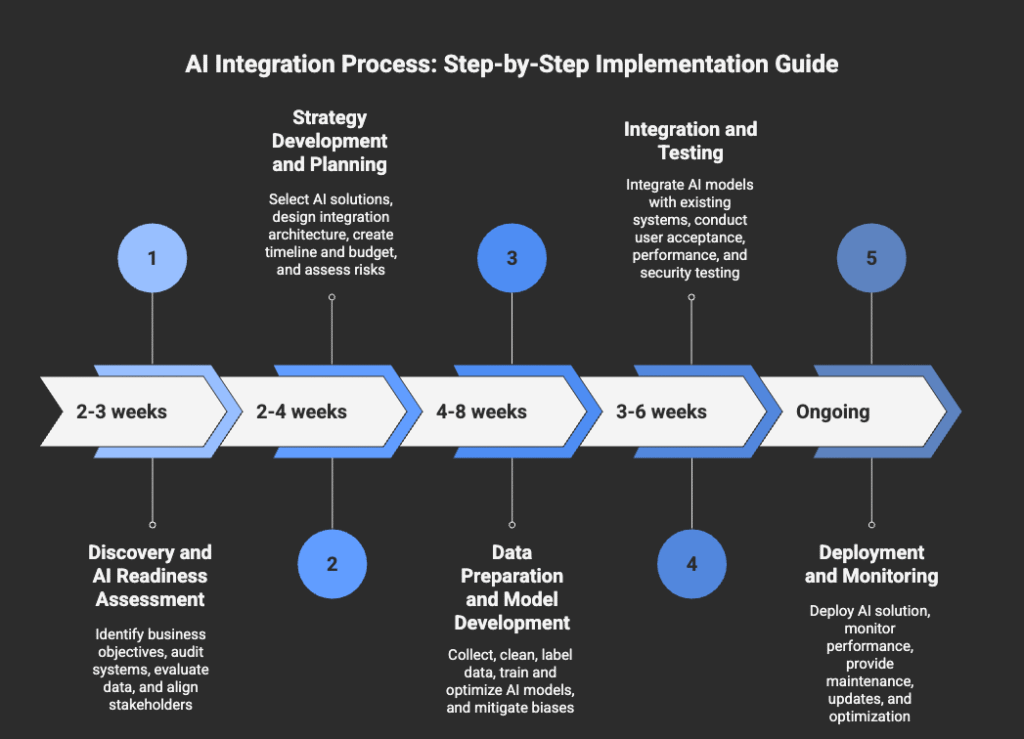
The AI Integration Process: Step-by-Step Implementation Guide
Successful AI integration requires a structured and strategic approach. This five-phase process provides a roadmap for businesses to follow, from initial discovery to ongoing optimization.
Phase 1 – Discovery and AI Readiness Assessment (2-3 weeks)
The first step is to identify the business objectives you want to achieve with AI and assess your organization’s readiness. This involves auditing your current systems, evaluating your data quality, and prioritizing potential use cases based on their potential ROI. It is crucial to align all stakeholders around a common vision and set clear, measurable goals for the project.
Phase 2 – Strategy Development and Planning (2-4 weeks)
Once you have identified your goals, the next step is to develop a detailed strategy and plan. This includes selecting the right AI solutions and technology stack, designing the integration architecture, and creating a realistic timeline and budget. A thorough risk assessment should also be conducted to identify potential challenges and develop mitigation strategies.
Phase 3 – Data Preparation and Model Development (4-8 weeks)
Data is the lifeblood of any AI system. This phase involves collecting, cleaning, and labeling the data that will be used to train your AI models. The models are then trained, tested, and optimized to ensure they meet the required accuracy and performance standards. It is also critical to check for and mitigate any potential biases in the data to ensure fair and ethical outcomes.
Phase 4 – Integration and Testing (3-6 weeks)
This is where the AI models are integrated with your existing business systems. This often involves developing custom APIs and middleware to ensure seamless communication between different platforms. Rigorous testing, including user acceptance testing (UAT), performance testing, and security testing, is essential to ensure the integrated system is robust, reliable, and secure.
Phase 5 – Deployment and Monitoring (Ongoing)
The final phase is to deploy the integrated AI solution. A phased rollout strategy is often recommended to minimize disruption and allow for adjustments based on user feedback. Once deployed, the system must be continuously monitored to ensure it is performing as expected. Ongoing maintenance, updates, and optimization are necessary to ensure the long-term success of your AI integration.
AI Integration Costs and ROI in Dubai
One of the biggest questions for any business considering AI integration is the cost. While the investment can be significant, the potential ROI is often even greater. This section provides a transparent overview of AI integration costs and how to calculate the potential return on your investment.
Understanding AI Integration Costs in the UAE Market
The cost of AI integration can vary widely depending on the complexity of the project, the amount of data involved, and the level of customization required. Here is a general breakdown of potential costs in the UAE market:
| Project Size | Cost Range (AED) | Timeline | Typical Features |
| Small Business | 20,000 – 100,000 | 2-4 months | Chatbot integration, basic process automation |
| Mid-Market | 100,000 – 400,000 | 4-8 months | Custom ML models, predictive analytics |
| Enterprise | 400,000+ | 8-12+ months | Full-scale digital transformation, multiple integrated systems |
It is also important to factor in ongoing costs for maintenance, support, and model updates, which typically amount to 15-20% of the initial project cost annually.
Calculating ROI from AI Integration
The ROI from AI integration can be measured in several ways, including cost savings, revenue growth, and efficiency gains. A simple framework for calculating ROI is:
ROI = ( (Gain from Investment – Cost of Investment) / Cost of Investment ) * 100
For example, if a business invests AED 200,000 in an AI-powered lead qualification system that generates an additional AED 500,000 in revenue and saves AED 100,000 in labor costs over two years, the ROI would be:
ROI = ( (600,000 – 200,000) / 200,000 ) * 100 = 200%
Most businesses can expect to see a positive ROI from AI integration within 6-18 months.
Financing and Investment Options for AI Projects
For businesses that are hesitant to make a large upfront investment, there are several financing options available. The UAE government offers various grants and incentives for businesses investing in AI. A phased implementation can also help spread the cost over time. Additionally, some AI providers offer SaaS-based solutions with a monthly subscription fee, which can be a more affordable option for small businesses.
UAE Data Protection and AI Compliance Requirements
In the age of AI, data is the new oil. However, with great power comes great responsibility. The UAE has implemented a robust legal framework to govern the use of AI and protect personal data. Understanding and adhering to these regulations is not just a legal requirement; it is essential for building trust with your customers.
Understanding UAE PDPL (Personal Data Protection Law)
The cornerstone of the UAE’s data protection framework is the Federal Decree-Law No. 45 of 2021 on the Protection of Personal Data (PDPL). This law sets out the rules for collecting, processing, and storing personal data. Key requirements for AI systems include:
- Consent: Businesses must obtain clear and explicit consent from individuals before collecting or processing their personal data.
- Purpose Limitation: Data can only be used for the specific purpose for which it was collected.
- Data Minimization: Businesses should only collect the minimum amount of data necessary to achieve their stated purpose.
- Data Residency: In some cases, personal data may be required to be stored within the UAE.
Non-compliance with the PDPL can result in significant fines, making it crucial for businesses to ensure their AI systems are fully compliant.
AI Ethics and Governance in Dubai
Beyond the legal requirements of the PDPL, the UAE has also established an AI Ethics Framework to guide the responsible development and deployment of AI. This framework is based on eight guiding principles, including fairness, transparency, and accountability. Businesses are encouraged to adopt these principles to ensure their AI systems are not only legal but also ethical. The government has also created sandbox environments where businesses can test their AI solutions in a controlled setting to ensure they meet these ethical standards.
Ensuring PDPL Compliance in AI Integration
To ensure your AI integration is PDPL compliant, you should follow these best practices:
- Conduct a Data Protection Impact Assessment (DPIA) to identify and mitigate any potential risks to personal data.
- Implement strong security measures, including encryption and access controls, to protect data from unauthorized access.
- Be transparent with your customers about how you are using their data.
- Establish a clear process for handling data subject requests, such as requests for access or deletion of data.
Common AI Integration Challenges and How to Overcome Them
While the benefits of AI integration are clear, the path to implementation is not always smooth. Businesses often face a number of challenges, from data quality issues to resistance from employees. This section explores some of the most common challenges and provides practical solutions for overcoming them.
Data Quality and Availability Issues
AI models are only as good as the data they are trained on. Poor data quality can lead to inaccurate predictions and biased outcomes. To overcome this challenge, businesses should invest in a robust data governance framework to ensure their data is clean, accurate, and complete.
Legacy System Integration Difficulties
Integrating modern AI systems with legacy business software can be a major technical hurdle. APIs and middleware can be used to bridge the gap between old and new systems. A gradual migration strategy, where legacy systems are slowly phased out over time, can also be an effective approach.
Talent and Skills Gap in AI Implementation
The demand for AI talent far outstrips the supply, making it difficult for businesses to find and hire qualified AI specialists. To address this, businesses can invest in training their existing teams or partner with an experienced AI integration provider like CobraClicks.
Change Management and User Adoption
Employees may be resistant to AI adoption due to fears of job displacement or a lack of understanding of the technology. A strong change management strategy, including clear communication and comprehensive training, is essential to ensure smooth user adoption.
Security and Privacy Concerns
AI systems can introduce new security vulnerabilities and privacy risks. It is crucial to conduct a thorough security assessment and implement strong security measures, such as encryption and access controls, to protect your systems and data. Ensuring PDPL compliance is also a critical component of mitigating privacy risks.
How to Choose the Right AI Integration Partner in Dubai
Choosing the right AI integration partner is one of the most critical decisions you will make. The right partner will not only have the technical expertise to implement your AI solution but will also understand your business and the local market. This section provides a guide to selecting the right partner for your needs.
Key Criteria for Evaluating AI Service Providers
When evaluating potential partners, consider the following criteria:
- Technical Expertise: Do they have a proven track record in the specific AI technologies you need?
- Industry Experience: Do they have experience in your industry and understand its unique challenges?
- Local Market Knowledge: Do they understand the Dubai and UAE market, including local regulations and consumer behavior?
- PDPL Compliance Expertise: Can they ensure your AI solution is fully compliant with UAE data protection laws?
- Portfolio and Case Studies: Do they have a portfolio of successful projects with measurable results?
- Client Testimonials: What do their past clients say about them?
Essential Questions to Ask Potential AI Partners
To help you evaluate potential partners, here are some essential questions to ask:
- Can you provide case studies of similar projects you have completed?
- How do you ensure PDPL compliance?
- What is your implementation process and what are the typical timelines?
- What is your pricing structure and what is included in the cost?
- What kind of post-deployment support do you offer?
Red Flags to Watch Out For
Be wary of partners who:
- Make unrealistic promises of overnight success.
- Lack transparency in their pricing or process.
- Do not have a local presence or understanding of the UAE market.
- Cannot provide concrete examples of their work.
Real-World AI Integration Success Stories in Dubai
To illustrate the real-world impact of AI integration, here are three examples of how Dubai-based businesses have used AI to achieve significant results.
First Case Study 1: Retail Chain Increases Revenue by 35% with AI Personalization
- Challenge: A leading retail chain in Dubai was struggling to compete with online retailers and wanted to create a more personalized in-store experience.
- Solution: They partnered with CobraClicks to implement an AI-powered personalization engine that analyzed customer purchase history and browsing behavior to provide real-time product recommendations via in-store displays and a mobile app.
- Results: The solution led to a 35% increase in in-store sales and a 25% increase in customer loyalty.
Second Case Study 2: Healthcare Provider Reduces Diagnosis Time by 60%
- Challenge: A large hospital in Dubai was facing long wait times for diagnostic imaging results, leading to delays in patient treatment.
- Solution: They integrated an AI-powered medical imaging analysis tool that could assist radiologists in detecting anomalies in X-rays and MRIs.
- Results: The AI tool reduced the average diagnosis time by 60% and improved diagnostic accuracy by 15%.
Third Case Study 3: Logistics Company Cuts Operational Costs by 40%
- Challenge: A Dubai-based logistics company was struggling with high fuel costs and inefficient delivery routes.
- Solution: They implemented an AI-powered route optimization platform that analyzed traffic patterns, weather conditions, and delivery schedules in real-time to find the most efficient routes.
- Results: The platform reduced fuel costs by 40% and improved on-time delivery rates by 30%.
Future of AI Integration in Dubai: Trends and Predictions for 2025-2030
Dubai’s AI journey is just beginning. The coming years will see the emergence of even more advanced AI technologies and a deeper integration of AI into the fabric of society. This section explores some of the key trends and predictions that will shape the future of AI in Dubai.
Emerging AI Technologies Shaping Dubai’s Future
- Agentic AI: AI agents that can autonomously perform complex tasks will become more common, further automating business processes.
- Quantum AI: The convergence of quantum computing and AI will unlock unprecedented computational power, enabling the solution of previously unsolvable problems.
- Edge AI: Processing AI algorithms directly on devices (like smartphones and sensors) will enable real-time applications for smart cities.
Dubai 2030 Vision and AI’s Role
Dubai’s 2030 vision includes ambitious goals like making 25% of all journeys autonomous and creating a 100% paperless government. AI will be the driving force behind these initiatives, creating a hyper-connected and efficient urban environment.
Preparing Your Business for the AI-Driven Future
To stay competitive, businesses must start preparing for this AI-driven future today. This includes investing in skills development, building a robust data infrastructure, and fostering a culture of innovation.
Frequently Asked Questions About AI Integration in Dubai
Here are answers to some of the most common questions businesses have about AI integration in Dubai.
How long does AI integration take for a typical Dubai business?
The timeline for AI integration can range from 2-4 months for a small project to 8-12+ months for a large-scale enterprise solution. The complexity of the project and the quality of your data are the biggest factors affecting the timeline.
What is the average cost of AI integration in Dubai?
The cost can range from AED 50,000 for a simple chatbot integration to over AED 800,000 for a custom enterprise solution. It is important to get a detailed quote from your AI partner.
Do I need to hire AI specialists or can I outsource?
For most businesses, partnering with an experienced AI integration provider like CobraClicks is the most cost-effective and efficient approach. This gives you access to a team of experts without the high cost of hiring a full-time AI team.
Is my business data safe with AI integration?
Yes, as long as you work with a reputable partner who follows best practices for security and PDPL compliance. This includes using encryption, access controls, and conducting regular security audits.
Can AI integrate with my existing business systems?
Yes, modern AI solutions are designed to integrate with a wide range of business systems, including CRMs, ERPs, and marketing automation platforms, through the use of APIs.
What ROI can I expect from AI integration?
Most businesses can expect to see a positive ROI within 6-18 months. The exact ROI will depend on your specific use case, but it can be measured in terms of cost savings, revenue growth, and efficiency gains.
How does UAE PDPL affect AI implementation?
The PDPL requires businesses to obtain consent before collecting personal data, use it only for its stated purpose, and implement strong security measures. It is crucial to work with a partner who understands and can ensure compliance with these regulations.
What industries benefit most from AI integration in Dubai?
While all industries can benefit from AI, the sectors seeing the biggest impact in Dubai are financial services, retail, healthcare, real estate, and logistics.
Why Choose CobraClicks for AI Integration in Dubai
CobraClicks is more than just a digital marketing agency; we are your strategic partner in growth. We combine our deep expertise in digital marketing with cutting-edge AI solutions to help you achieve your business goals.
Our AI Integration Expertise
Our team of AI specialists has a proven track record of successfully implementing AI solutions for businesses across a wide range of industries in Dubai. We have the technical expertise and local market knowledge to deliver results.
Comprehensive Digital Marketing + AI Solutions
Our unique positioning at the intersection of digital marketing and AI allows us to create integrated solutions that drive real business impact. We don’t just build AI models; we ensure they are aligned with your marketing and sales goals to maximize your ROI.
PDPL-Compliant, Dubai-Focused Solutions
We understand the unique challenges and opportunities of the Dubai market. All of our solutions are fully compliant with UAE PDPL and are tailored to the specific needs of businesses in the region.
Conclusion: Transform Your Dubai Business with AI Integration
The age of artificial intelligence is here, and Dubai is at the forefront of this global transformation. For businesses in the UAE, AI integration is no longer a luxury; it is a necessity for staying competitive and achieving sustainable growth. By embracing AI, you can unlock new levels of efficiency, create hyper-personalized customer experiences, and make smarter, data-driven decisions.
The journey to AI integration may seem complex, but with the right strategy and the right partner, it is an achievable and highly rewarding endeavor. The time to act is now. The future of your business depends on it.
Ready to start your AI transformation journey?