

In Dubai’s hyper-competitive business landscape, operational efficiency is not just an advantage—it is a necessity for survival. As a global hub for commerce, finance, and innovation, Dubai presents unique challenges, including high operational costs and a diverse, multilingual customer base. Businesses are in a constant race to deliver exceptional customer experiences while managing expenses. This is where how Dubai companies are using AI voice agents to cut support costs becomes a critical conversation. This transformative technology is enabling businesses to slash customer support expenses by 60-90%, enhance customer satisfaction, and gain a significant competitive edge.With the UAE government’s ambitious AI strategy, including a 97% AI adoption rate across government entities and over AED 543 billion in AI-related investments, the stage is set for a revolution in customer service (as reported by the Khaleej Times). This article explores how leading Dubai companies are leveraging AI voice agents, providing real-world case studies, a detailed cost-saving analysis, and a step-by-step guide for implementation.
The Customer Support Challenge Facing Dubai Businesses
Operating a customer support center in Dubai is a costly endeavor. High operational costs, including salaries, office space, and infrastructure, are significant financial burdens. The average salary for a call center agent in Dubai ranges from AED 5,000 to AED 8,000 per month, and high turnover rates of 30-45% annually mean that companies face recurring recruitment and training costs of AED 37,000 to AED 74,000 per agent, according to the Society for Human Resource Management (SHRM). Beyond the financial strain, Dubai’s uniquely diverse and international population presents a significant multilingual challenge. Businesses must be prepared to offer support in a multitude of languages, including Arabic, English, Hindi, Urdu, and more, to cater to a global clientele that expects 24/7 service. Traditional call centers struggle to meet these demands efficiently, often leading to long wait times, inconsistent service quality, and a diminished customer experience. These limitations are particularly acute in key Dubai industries such as real estate, where immediate responses are critical for high-value transactions; hospitality, which serves a constant influx of international guests; and retail, which experiences dramatic peaks in demand during shopping seasons.
Understanding AI Voice Agents: Technology Powering Dubai’s Customer Service Revolution
AI voice agents represent a significant leap forward from traditional automated systems. They are sophisticated, AI-powered virtual agents capable of understanding and responding to human speech in a natural, conversational manner. Unlike their rigid, menu-driven predecessors, AI voice agents can handle complex queries, understand context, and even detect sentiment, providing a customer experience that is both efficient and empathetic.
How AI Voice Agents Work
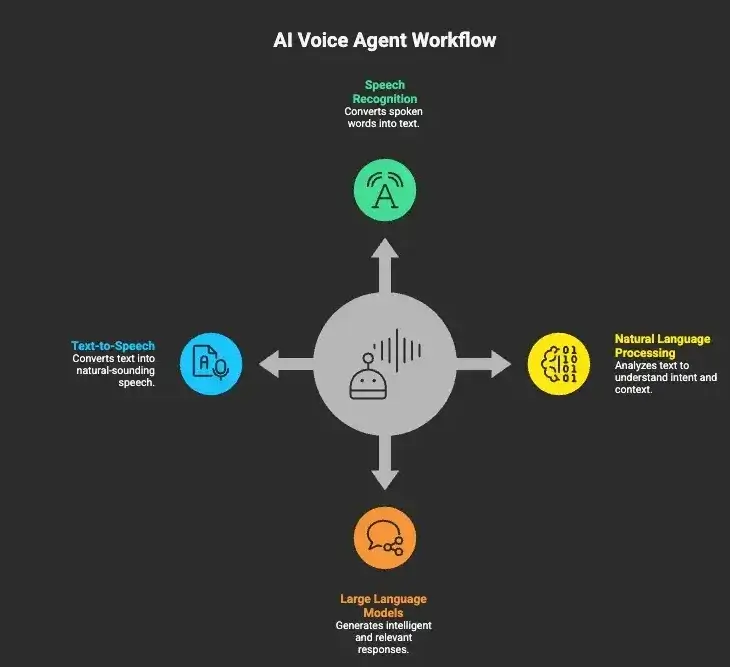
The technology behind AI voice agents is a symphony of advanced AI components working in seamless integration:
- Automatic Speech Recognition (ASR): This is the initial step where the agent “listens.” ASR technology converts spoken language into machine-readable text, forming the foundation for understanding.
- Natural Language Processing (NLP): Once the speech is converted to text, NLP algorithms analyze the text to decipher the user’s intent, extract key information (like names, dates, or order numbers), and understand the context of the conversation.
- Large Language Models (LLMs): At the core of the agent’s intelligence are LLMs, the same technology that powers advanced systems like ChatGPT. These models generate intelligent, relevant, and contextually appropriate responses.
- Text-to-Speech (TTS): In the final step, TTS technology converts the AI-generated text response back into natural-sounding human speech, completing the conversational loop.
AI Voice Agents vs. Traditional IVR
The difference between a modern AI voice agent and a traditional Interactive Voice Response (IVR) system is night and day. While IVRs force customers into rigid, pre-defined menus (“Press 1 for sales, Press 2 for support”), AI voice agents offer a fluid, conversational experience. The following table highlights the key distinctions:
| Feature | Traditional IVR | AI Voice Agents |
| Conversation Style | Menu-based, rigid | Natural, conversational |
| Language Support | Limited, single language | Multiple languages & dialects |
| Learning Capability | Static, pre-programmed | Continuous learning & improvement |
| Complex Queries | Requires immediate human transfer | Can handle multi-step queries autonomously |
| Cultural Awareness | None | Adapts to cultural context and etiquette |
| Integration | Basic, limited | Deep integration with CRM, ERP, and other business systems |
This technological superiority allows AI voice agents to not only handle a wider range of tasks but also to create a more positive and engaging customer experience, which is crucial in the discerning Dubai market.
Real Dubai Companies Achieving 60-90% Cost Savings with AI Voice Agents
Across Dubai’s most critical industries, from banking and e-commerce to telecommunications and even government services, AI voice agents are delivering transformative results. The theoretical benefits of this technology are being realized in the form of massive cost reductions, enhanced customer satisfaction, and unprecedented operational efficiency. The following case studies showcase how leading Dubai-based organizations are successfully implementing AI customer service Dubai solutions to overcome local challenges and set new standards in customer experience.
Banking & Financial Services: Emirates NBD’s EVA
As one of the UAE’s largest and most respected banks, Emirates NBD faced the dual challenge of managing immense call volumes while providing secure, high-quality service. The bank’s solution was to launch EVA (Emirates Virtual Assistant), a sophisticated conversational AI integrated across its website, mobile app, and phone banking channels. EVA empowers customers to perform a wide range of banking tasks—from checking balances and transaction histories to transferring funds and paying bills—all through natural voice commands. The results have been staggering.Emirates NBD reported a 20% reduction in call center volume and a 35% drop in average response time compared to traditional phone support, as highlighted in a case study by Louis Pretorius.is successful implementation of customer support automation UAE not only generated millions in annual savings but also freed up human agents to focus on more complex financial advisory roles, thereby elevating the overall value of their customer service.
E-commerce: Noon’s AI-Powered Customer Support
Noon, the UAE’s homegrown e-commerce powerhouse, contends with millions of customer interactions daily, from order tracking and product questions to returns and refunds. Scaling a human support team to manage this volume would be financially unsustainable. Instead, Noon embraced AI voice agents Dubai to automate a significant portion of these interactions. Their AI-powered chatbots and voice assistants provide instant order tracking updates, answer product-related questions using a comprehensive knowledge base, and even guide users through the automated refund and exchange processes. This strategic automation has drastically reduced customer wait times from several minutes to under 30 seconds, leading to a notable increase in repeat purchases and customer loyalty. By handling the high volume of routine inquiries, Noon’s AI has obviated the need to hire hundreds of additional support staff, resulting in an estimated 60-70% reduction in support costs and millions of dirhams in annual savings.
Telecommunications: Etisalat’s Bilingual AI Assistant “Eya”
In the competitive UAE telecommunications market, Etisalat distinguished itself by launching “Eya,” an advanced AI-powered virtual assistant fluent in both Arabic and English. Available across the company’s website, mobile app, and WhatsApp, Eya is a prime example of leveraging Arabic voice AI to cater to the nation’s diverse population. The assistant adeptly handles a wide array of customer needs, including bill inquiries, plan upgrades, and technical troubleshooting. What makes Eya particularly effective is its ability to understand various Gulf Arabic dialects and seamlessly handle code-switching. Within the first three months of its launch, Eya was able to resolve 70% of queries without any human involvement. This remarkable success has allowed Etisalat’s human agents to concentrate on more complex technical and sales-related issues, leading to a 50-60% reduction in call center operational costs and a more efficient, inclusive customer service model.
Food Delivery: Talabat’s Peak-Time AI Support
For Talabat, the leading food delivery service in the UAE, customer support is a race against the clock. During peak lunch and dinner hours, the volume of urgent inquiries—from order modifications to delivery status updates—can be overwhelming. To address this, Talabat deployed an AI-powered support system to provide instant responses to frequently asked questions. The AI assists customers with live order tracking through chat and intelligently routes more complex issues to human agents, ensuring that every query is addressed with maximum speed. This has resulted in a more than 50% improvement in first-response time and a significant increase in customer retention. By automating support during its busiest periods, Talabat has been able to reduce its reliance on seasonal staff and achieve a 55-65% reduction in support costs during peak times.
Real Estate: Dubai Property Firms Leveraging Voice AI
The high-stakes Dubai real estate market, with its international clientele and high-value transactions, is another sector reaping the benefits of voice AI Dubai companies. Property firms are using AI voice agents to provide 24/7 availability for property inquiries and to schedule viewing appointments across different time zones. These AI agents can qualify leads by asking pre-programmed questions and can even conduct follow-up calls in multiple languages. The impact has been profound, with agencies reporting a 30% increase in lead engagement and a 40% higher response rate after integrating voice AI, as reported by Trixly AI This was reported by Trixly AI. This has led to a threefold increase in booking conversions and a significant reduction in lead management costs.
Hospitality: Palazzo Versace Dubai’s AI Guest System
In the luxury hospitality sector, Palazzo Versace Dubai has set a new standard by launching the industry’s first fully-integrated AI automation system for guest communications. This system handles a wide range of guest services, from booking confirmations and check-in assistance to concierge requests and room service orders, all in multiple languages. This innovative use of UAE hospitality AI automation has not only enhanced the guest experience by providing instant, 24/7 support but has also improved operational efficiency by reducing the workload on front desk staff. The hotel has achieved an estimated 40-50% reduction in guest services costs, allowing its staff to focus on providing high-touch, personalized services that define the luxury experience, as announced in a press release as announced in a press release.
Government Services: Dubai Police Virtual Assistant
Even public sector organizations are embracing AI to improve service delivery and efficiency. The Dubai Police has launched a smart virtual assistant on its website and app to assist residents and tourists with a variety of services, including traffic fine inquiries, complaint filing, and accessing general information. This initiative has successfully reduced foot traffic to physical police stations and enhanced accessibility for non-Arabic speakers. By automating routine administrative tasks, the Dubai Police has not only increased citizen trust through faster, more transparent service but has also achieved significant cost efficiencies, allowing for better allocation of resources to critical public safety operations.
Breaking Down the 60-90% Cost Savings: Where Dubai Companies Save Money
The dramatic cost reductions that Dubai companies are achieving with AI voice agents are the result of savings across multiple operational domains. By replacing or augmenting traditional support models, AI delivers efficiencies that go far beyond simply reducing headcount. The following is a detailed financial analysis of how these savings are realized.
Labor Cost Savings
The most significant savings come from a reduction in labor costs. A traditional call center agent in Dubai costs a business between AED 7,000 and AED 11,500 per month when salary, benefits, and workspace are factored in. In contrast, a sophisticated AI voice agent, capable of handling the workload of 5 to 10 human agents, typically costs between AED 1,900 and AED 3,000 per month. This translates to a staggering 62-91% reduction in direct labor costs for the tasks handled by the AI.
Training & Onboarding Cost Elimination
High turnover rates in call centers necessitate a constant cycle of recruitment and training, costing companies AED 8,000 to AED 15,000 per agent annually. AI voice agents eliminate these costs entirely. Once configured, an AI agent is fully “trained” and can be updated with new information instantly and at no additional cost, ensuring 100% consistency and compliance with company policies.
Turnover Cost Avoidance
With annual turnover rates in the call center industry hovering between 30% and 45%, the cost of replacing an agent—including recruitment, training, and lost productivity—can be as high as AED 74,000. AI voice agents have zero turnover. They operate 24/7 with 100% retention, providing a stable and reliable customer support backbone that is immune to the costly churn of a human workforce.
Operational and Infrastructure Cost Reduction
Beyond labor, AI voice agents deliver substantial savings on operational and infrastructure overhead. The table below provides a conservative monthly cost comparison per agent, illustrating the financial advantages of an AI-driven support model.
For a mid-sized Dubai e-commerce company with a 50-agent call center, the financial implications are profound. A traditional support model could cost between AED 475,000 and AED 800,000 per month. By transitioning to a hybrid model where AI handles the majority of routine inquiries, the monthly cost can be reduced to between AED 50,000 and AED 100,000. This represents a potential annual saving of AED 5.1 million to AED 8.4 million, with a return on investment (ROI) often realized in as little as 2 to 4 months.
Why Arabic Language Support Makes AI Voice Agents Essential for Dubai
In the multicultural melting pot of Dubai, where over 200 nationalities converge, a monolingual customer service strategy is a recipe for failure. The ability to communicate with customers in their native language is not just a courtesy—it is a fundamental business requirement. This is where AI voice agents offer a powerful and essential advantage, particularly in their advanced support for the Arabic language.
Advanced Arabic AI Capabilities
Modern AI voice platforms have made significant strides in mastering the complexities of the Arabic language. Leading systems like NEVOX AI and the UAE-built Munsit model from CNTXT AI now support over 15 different Arabic dialects, including Gulf Arabic (spoken in the UAE, Saudi Arabia, and Qatar), Levantine Arabic, and Egyptian Arabic, as reported by the Khaleej Times as reported by the Khaleej Times. This allows for a level of localization that was previously unimaginable. Furthermore, these platforms are adept at handling “code-switching,” the common practice in Dubai of seamlessly transitioning between Arabic and English within the same conversation. This capability ensures a natural and fluid interaction that mirrors how a large portion of the population communicates in daily life.
Cultural Adaptation and Competitive Advantage
Beyond language, these AI agents are programmed for cultural adaptation. They can be configured to use appropriate greetings like “As-salamu alaykum,” use respectful titles such as “Sayed” or “Sayeda,” and even acknowledge cultural events like Ramadan and Eid. This cultural sensitivity demonstrates a deep market understanding and builds a stronger sense of trust and connection with customers. The success of Etisalat’s bilingual assistant, “Eya,” which was praised for its cultural awareness, underscores the importance of this capability. By offering high-quality, culturally-aware support in multiple languages, businesses can broaden their market reach, enhance customer trust, and gain a significant competitive advantage without the high cost and complexity of hiring a large team of multilingual agents.
How to Implement AI Voice Agents in Your Dubai Business: A Step-by-Step Guide
Transitioning to an AI-powered customer support model is a strategic initiative that, when executed correctly, can deliver rapid and substantial returns. For Dubai businesses, a successful implementation requires a clear understanding of local needs, careful platform selection, and a phased rollout. The following six-step guide provides a practical roadmap for deploying AI voice agents and beginning the journey toward significant cost savings.
Step 1: Assess Your Needs (Weeks 1-2)
Before engaging with any vendors, conduct a thorough internal audit of your current support operations. Identify the most frequent and repetitive customer inquiries, analyze your call volumes and peak times, and calculate your current cost per interaction. It is also crucial to identify the primary languages your customers speak and the business systems (like your CRM or ERP) that will require integration. This initial assessment will allow you to set clear, measurable goals for your AI implementation, such as a target cost reduction or a specific improvement in response time.
Step 2: Choose the Right AI Voice Platform (Weeks 3-4)
Selecting the right technology partner is the most critical decision in this process. For the Dubai market, prioritize platforms that offer robust Gulf Arabic dialect support, proven code-switching capabilities, and a deep understanding of local cultural nuances. Ensure the vendor is compliant with UAE regulations, including the Personal Data Protection Law (PDPL) and the requirements of the Telecommunications and Digital Government Regulatory Authority (TDRA). Platforms with a local presence and Arabic-speaking support teams, such as Brightcall.ai or NEVOX AI, can offer significant advantages in implementation and ongoing support.
Step 3: Plan Your Implementation (Weeks 5-6)
Rather than a full-scale, high-risk launch, adopt a phased pilot program approach. Begin by automating 10-20% of your call volume, focusing on the most common and straightforward inquiries identified in your assessment. This allows you to test and refine the AI in a controlled environment before a full customer-facing launch. During this phase, it is essential to prepare your human support team, positioning the AI as a helpful assistant rather than a replacement, and training them on the new escalation protocols.
Step 4: Configure & Train Your AI Agent (Weeks 7-10)
This is where you bring your AI voice agent to life. Begin by building a comprehensive knowledge base with answers to frequently asked questions, product information, and company policies. Design conversation flows that are natural and intuitive, and program the AI with culturally appropriate greetings and responses. Thoroughly test the system with your internal team, covering a wide range of scenarios, languages, and potential edge cases.
Step 5: Launch & Monitor (Weeks 11-12)
Start with a soft launch to a limited segment of your customer base. Monitor the AI’s performance closely, review conversation logs, and gather customer feedback to make real-time adjustments. Once you are confident in the system’s performance, proceed with a full launch, communicating the new service to your customers through your website, email, and social media channels. It is crucial to maintain a human backup option for customers who prefer it or for issues that the AI cannot resolve.
Step 6: Measure ROI & Scale (Months 3-6)
Continuously track your key performance indicators (KPIs), including cost per interaction, first-call resolution rate, and customer satisfaction scores. Calculate your return on investment to demonstrate the financial benefits to stakeholders. Based on the data and insights gathered, you can begin to scale the AI’s capabilities, expanding to more complex inquiry types, adding more languages, and integrating it across additional customer communication channels like WhatsApp and SMS.
Overcoming Challenges: Best Practices for AI Voice Agent Success in Dubai
While the benefits of AI voice agents are compelling, a successful implementation requires navigating a unique set of challenges specific to the Dubai market. By anticipating these hurdles and adopting proven best practices, businesses can ensure a smooth transition and maximize their return on investment.
One of the primary concerns for many businesses is the initial investment. While a full-scale implementation can have a significant upfront cost, the rapid ROI of 2-4 months typically justifies the expenditure. Starting with a smaller, more affordable pilot program is an effective way to prove the value and build a business case for a larger investment. Another significant challenge is ensuring cultural and linguistic accuracy. The best practice is to involve local, native-speaking team members in the conversation design process and to choose a platform with a proven track record in the Gulf region. Employee resistance can also be a hurdle, but this can be mitigated by transparent communication that frames the AI as a tool to augment, not replace, human agents, allowing them to focus on more engaging and higher-value work. Finally, the most successful implementations embrace a hybrid model, where the AI handles the majority of routine inquiries, with a seamless and intelligent escalation path to a human agent for complex, sensitive, or high-value interactions.
The Future of AI Voice Agents in Dubai: What’s Next?
Dubai’s journey with AI is only just beginning. Guided by the ambitious goals of the Smart Dubai 2030 vision and the UAE’s National Strategy for Artificial Intelligence, the landscape of customer service is set for even more dramatic transformations. We are on the cusp of a new era where emerging technologies like Emotion AI will allow voice agents to detect customer sentiment and adapt their responses with empathy, and voice cloning will enable the creation of hyper-realistic, brand-specific voice personalities. As the technology matures, we can expect AI to move beyond reactive support to predictive AI, anticipating customer needs and proactively offering solutions. The continued development of advanced Arabic NLP will further enhance the ability of AI to understand the subtle nuances of regional dialects and cultures, making interactions virtually indistinguishable from those with a human. By 2027, it is predicted that over 80% of Dubai businesses will be using AI voice agents, with the technology becoming a standard, indispensable component of the customer service ecosystem.
Transform Your Dubai Business with AI Voice Agents
In Dubai’s fast-paced and competitive market, AI voice agents have proven to be a game-changing technology, enabling companies to achieve unprecedented cost savings of 60-90% while simultaneously enhancing the customer experience. As demonstrated by the success of industry leaders like Emirates NBD, Noon, and Etisalat, the question is no longer if businesses should adopt this technology, but how quickly they can implement it to stay ahead of the competition. With a typical ROI of just 2-4 months, the financial case is as compelling as the strategic one.
Ready to revolutionize your customer support and unlock massive cost savings? CobraClicks specializes in helping UAE businesses design and implement bespoke AI voice agent solutions tailored to the unique linguistic and cultural landscape of the Dubai market. Our digital marketing expertise ensures a seamless integration that delivers measurable results.
Contact us today for a free AI Voice Agent consultation** and receive a complimentary ROI calculation for your business.**
Frequently Asked Questions About AI Voice Agents in Dubai
Q1: How much can Dubai companies realistically save with AI voice agents?
A: Dubai companies typically achieve 60-90% cost savings on customer support operations. For example, a company spending AED 500,000/month on a 50-agent call center can reduce costs to AED 50,000-100,000/month with AI voice agents. Real case studies show Emirates NBD saved 20% in call center volume, while Etisalat resolved 70% of queries without human intervention.
Q2: Do AI voice agents support Arabic language and Gulf dialects?
A: Yes, modern AI voice agents like NEVOX AI and CNTXT AI’s Munsit model support 15+ Arabic dialects including Gulf Arabic (UAE, Saudi, Qatar, Kuwait), Levantine, and Egyptian. They also handle code-switching between Arabic and English mid-conversation, which is essential for Dubai’s multilingual market. Platforms like Etisalat’s “Eya” demonstrate successful bilingual implementation.
Q3: What industries in Dubai benefit most from AI voice agents?
A: All customer-facing industries benefit, but particularly: Banking & Financial Services (Emirates NBD’s EVA), E-commerce (Noon), Telecommunications (Etisalat), Food Delivery (Talabat), Real Estate (30% increase in lead engagement), Hospitality (Palazzo Versace Dubai), and Government Services (Dubai Police). Any industry with high call volumes and routine inquiries sees significant ROI.
Q4: How long does it take to implement AI voice agents in Dubai?
A: Full implementation typically takes 3-6 months: 2 weeks for assessment, 2 weeks for platform selection, 2 weeks for planning, 4 weeks for configuration and training, 2 weeks for launch, and 3-6 months for optimization. However, pilot programs can launch in 6-8 weeks. ROI is typically achieved within 2-4 months of full deployment.
Q5: Are AI voice agents compliant with UAE regulations?
A: Yes, reputable AI voice platforms comply with UAE PDPL (Personal Data Protection Law) and TDRA (Telecommunications and Digital Government Regulatory Authority) requirements. Choose platforms with UAE data residency, ISO certifications, and local support. Always verify compliance during vendor selection and conduct regular security audits.
Q6: Will AI voice agents replace human customer service agents?
A: No, the most successful approach is a hybrid model where AI handles 70-80% of routine inquiries (FAQs, order tracking, balance inquiries) while human agents focus on complex issues, high-value sales, and situations requiring empathy and judgment. This improves job satisfaction for human agents and reduces burnout while dramatically cutting costs.
Q7: What’s the ROI timeline for AI voice agents in Dubai?
A: Most Dubai businesses achieve positive ROI within 2-4 months. For example, a company spending AED 500,000/month on traditional support can save AED 400,000/month with AI (80% reduction). With implementation costs of AED 100,000-200,000, payback occurs in 3-6 months. Long-term ROI can reach 300-400% by Year 3, with continuous cost savings and efficiency gains.