

In the heart of one of the world’s most dynamic business hubs, companies are generating data and information at an unprecedented rate. The rapid growth and digital-first mindset of Dubai create immense opportunities, but they also lead to a significant challenge: an explosion of information that can overwhelm even the most efficient organizations. For businesses aiming to thrive in this competitive landscape, the ability to effectively AI to manage information in Dubai is no longer a luxury—it is a strategic necessity for survival and sustainable growth. This guide provides a comprehensive roadmap for leveraging artificial intelligence to transform your information management, covering the critical benefits, top-tier tools, a step-by-step implementation plan, and exclusive local case studies to guide your journey.
As a leading digital marketing agency, Cobraclicks has seen firsthand how structured information fuels growth. This article distills our expertise in digital transformation to provide you with an actionable framework for harnessing the power of AI.
Why AI for Information Management is Critical for Dubai Businesses
The unique business environment of Dubai—characterized by its fast pace, diverse workforce, and intense competition—demands unparalleled agility. Traditional methods of information management, which rely on manual processes and disconnected systems, are no longer adequate. This leads to several critical business challenges that artificial intelligence is uniquely positioned to solve.
Information overload slows down decision-making, unstructured data from emails and documents remains an untapped resource, and data silos prevent a unified view of the organization. Furthermore, manual workflows are prone to human error, and navigating the complex regulatory landscape requires constant vigilance. AI-powered solutions directly address these pain points, turning information from a burdensome liability into a strategic asset. The adoption of AI also aligns perfectly with the UAE’s national vision, particularly the UAE AI Strategy 2031, which aims to establish the nation as a global leader in artificial intelligence .
| Challenge | How AI Solves It |
| Information Overload | Automated classification, summarization, and prioritization of data. |
| Unstructured Data | Natural Language Processing (NLP) and computer vision to analyze documents, emails, and images. |
| Data Silos | Centralized knowledge hubs and intelligent search to unify information across departments. |
| Manual Processes | Workflow automation and intelligent document processing (IDP) to eliminate repetitive tasks. |
| Compliance & Risk | Automated data governance, policy enforcement, and real-time monitoring. |
Top 5 AI Information Management Solutions for Dubai Companies
Choosing the right technology is a critical step in leveraging AI to manage information. The market offers a wide range of platforms, each with unique strengths. Based on our analysis, here is a comparison of leading solutions well-suited for the Dubai market, including established global players and promising local providers.
| Feature | Microsoft 365 Copilot | M-Files | OpenText | IBM Watson | [Local Provider Example] |
| Best For | Integrated office productivity & collaboration | Document-heavy industries (legal, finance) | Large enterprises with complex governance needs | Custom AI development & deep analytics | Local support, compliance, and Arabic NLP |
| Key AI Features | In-app assistance, summarization, content generation | Metadata automation, OCR, intelligent search | Content analytics, risk management, eDiscovery | Advanced NLP, custom models, predictive analytics | Specialized Arabic language support & local data residency |
| Pricing Model | Per user/month subscription | Tiered subscription based on features & users | Enterprise license agreements | Usage-based (APIs) | Project-based or subscription |
| Dubai Presence | Strong, with local data centers | Regional partners and resellers | Established office in Dubai | Strong regional presence | Headquartered in Dubai/UAE |
Microsoft 365 Copilot: AI for Everyday Productivity
Microsoft 365 Copilot integrates the power of large language models (LLMs) directly into the Microsoft Office suite (Word, Excel, PowerPoint, Outlook, Teams). For Dubai businesses already invested in the Microsoft ecosystem, it offers a seamless way to enhance productivity. Its key benefit is its ability to work with your existing data to summarize long email threads, generate draft documents, create presentations, and analyze data in Excel using natural language commands. This makes it an excellent entry point for companies looking to introduce AI without deploying a standalone system.
M-Files: Intelligent Document Management
M-Files is a leader in metadata-driven document management, using AI to automatically classify, organize, and secure information regardless of where it is stored. Its AI capabilities, known as M-Files Aino, can analyze documents to extract key information, assign metadata, and ensure compliance with retention policies. This is particularly valuable for Dubai’s real estate, legal, and financial sectors, where document control and compliance are paramount.
OpenText: Enterprise-Grade Information Governance
OpenText provides a comprehensive suite of information management solutions designed for large, complex enterprises. Its AI platform, OpenText Aviator, offers a wide range of capabilities, from content analytics and eDiscovery to intelligent automation. For multinational corporations operating in Dubai, OpenText provides the robust governance, security, and scalability required to manage information across global operations while adhering to local regulations.
IBM Watson: Custom AI and NLP Solutions
IBM Watson is not a single product but a suite of AI services and APIs that allow businesses to build custom applications. Its strengths lie in its powerful Natural Language Processing (NLP) and understanding capabilities, which can be used to build sophisticated chatbots, analyze customer feedback, or develop predictive models. Companies in Dubai with unique requirements or those looking to build a proprietary AI solution often turn to IBM Watson for its flexibility and power.
[Local Provider Example]: Tailored for the UAE Market
Dubai and the wider UAE are home to a growing number of technology companies developing AI solutions specifically for the regional market. These providers offer significant advantages, including specialized Arabic language NLP models, a deep understanding of local business culture and regulations, and local data residency to comply with data sovereignty laws. Partnering with a local provider can ensure a solution that is perfectly attuned to the nuances of the Dubai market.
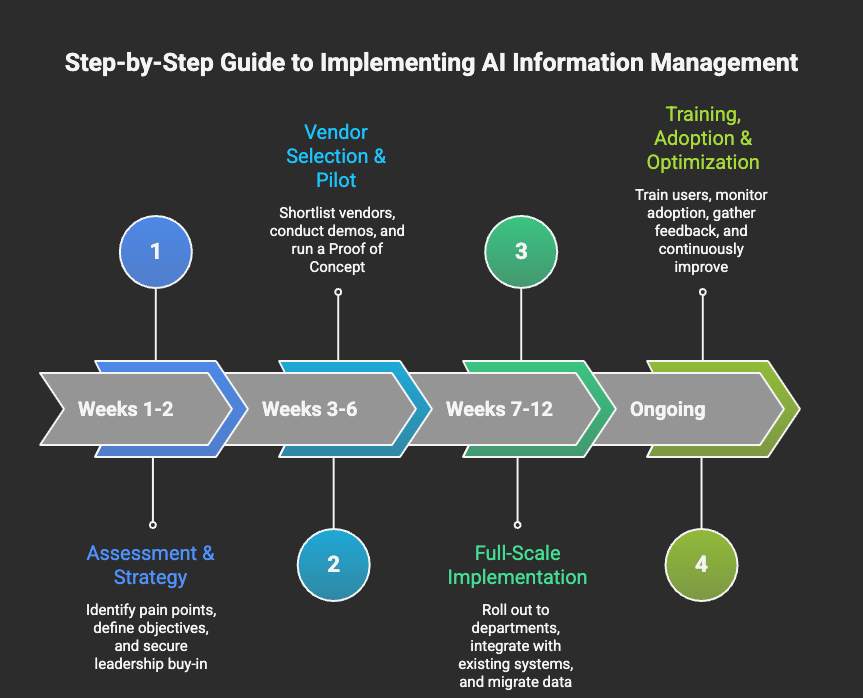
Your Step-by-Step Guide to Implementing AI Information Management
Adopting an AI-powered information management system is a transformative project that requires careful planning and execution. Following a structured, phased approach ensures a successful implementation that delivers measurable business value.
Phase 1: Assessment & Strategy (Weeks 1-2)
First, you must understand your starting point and define your destination. Begin by identifying your most significant information pain points through internal surveys, workshops, and interviews with key personnel. Are teams struggling to find documents? Are manual processes causing delays? Once you have identified the problems, define clear, measurable objectives. A good objective is specific, such as “reduce document retrieval time by 30% within six months” or “automate 80% of invoice processing.” Finally, secure buy-in from leadership by presenting a compelling business case that outlines the expected costs, benefits, and return on investment (ROI).
Phase 2: Vendor Selection & Pilot Program (Weeks 3-6)
With a clear strategy in place, the next step is to choose the right partner and technology. Use the comparison in the previous section as a starting point to create a shortlist of potential AI vendors. Invite the top 2-3 vendors to provide a demonstration tailored to your specific use case. The most critical part of this phase is running a Proof of Concept (PoC). Select a small, controlled project—for example, managing contracts for a single department—and test the vendor’s solution in a real-world environment. Evaluate the PoC’s success against the predefined metrics to make a data-driven decision.
Phase 3: Full-Scale Implementation & Integration (Weeks 7-12)
After selecting a vendor, move from the pilot to a full-scale rollout. It is crucial to develop a phased implementation plan; avoid a “big bang” approach. Start with a single department or business unit before expanding across the organization. A key technical task in this phase is integrating the new AI platform with your existing systems, such as your Customer Relationship Management (CRM) or Enterprise Resource Planning (ERP) software, using APIs and middleware. This ensures a seamless flow of information. Additionally, plan for data migration and cleansing to ensure the AI has high-quality data to work with.
Phase 4: Training, Adoption & Optimization (Ongoing)
Technology is only effective if people use it. Conduct comprehensive user training that focuses not just on how to use the new system, but also on how it will benefit employees in their daily work. Monitor user adoption rates and gather feedback through regular check-ins and surveys. Use the platform’s analytics to track usage patterns and identify areas for improvement. Finally, treat your AI implementation as a living project. Continuously optimize and refine the AI models, workflows, and user experience to maximize its value over time.
Real-World Success: AI Information Management in Dubai
Theory and frameworks are valuable, but seeing how local companies are succeeding with AI provides tangible proof of its impact. Here are three anonymized case studies based on real-world scenarios in Dubai.
Case Study 1: A Dubai Real Estate Firm Automates Contract Management
- Challenge: A prominent real estate developer was struggling to manage thousands of sales agreements, leasing contracts, and supplier documents. Manual processing led to delays, compliance risks, and difficulty in finding critical information.
- Solution: They implemented an AI-powered document management system with intelligent document processing (IDP). The system automatically ingested contracts, used NLP to extract key data points (e.g., dates, names, financial terms), and classified the documents based on their type.
- Results: The firm achieved a 50% faster contract processing time, significantly improved compliance with RERA regulations, and reduced legal risks by ensuring all documents were complete and accessible.
Case Study 2: A DIFC Financial Services Company Enhances Compliance
- Challenge: A wealth management firm based in the Dubai International Financial Centre (DIFC) needed to adhere to stringent anti-money laundering (AML) and know-your-customer (KYC) regulations. Manual checks were time-consuming and prone to error.
- Solution: The company deployed an AI tool that automated the monitoring of transactions and client communications for suspicious activity. The system flagged potential compliance breaches in real-time, allowing the compliance team to investigate immediately.
- Results: This led to a 90% reduction in manual compliance checks and provided a clear, auditable trail for regulators, resulting in zero penalties since implementation.
Case Study 3: A Local Retail Group Optimizes Inventory Information
- Challenge: A large retail group with stores across the UAE faced chronic issues with inaccurate inventory data, leading to stockouts of popular items and overstocking of others.
- Solution: They integrated an AI platform that analyzed historical sales data, real-time foot traffic from in-store sensors, and even local events to predict product demand. This provided accurate, forward-looking inventory information.
- Results: The retailer achieved a 20% reduction in stockouts, improved supply chain efficiency, and increased overall sales through better data-driven decision-making.
Overcoming Challenges in Your AI Implementation
While the benefits of AI are clear, the path to implementation can have its obstacles. Being aware of these common challenges allows you to plan for them proactively.
Challenge: Poor Data Quality
AI systems are only as good as the data they are trained on. If your existing data is inconsistent, incomplete, or inaccurate, the AI’s output will be unreliable. Solution: Before implementation, invest in a data governance framework. Use AI-powered data cleansing and preparation tools to improve the quality of your data assets. Start with a clean foundation.
Challenge: Employee Resistance to Change
Employees may be hesitant to adopt new tools, fearing that AI will replace their jobs or that the new system will be too complex. Solution: Develop a robust change management program. Communicate the benefits of AI clearly—how it will automate tedious tasks and free them up for more strategic work. Provide thorough, hands-on training and celebrate early wins to build momentum.
Challenge: Integration with Legacy Systems
Most companies have existing IT infrastructure that the new AI platform must connect with. Integrating modern AI tools with older, legacy systems can be technically complex. Solution: Prioritize AI vendors that offer strong integration capabilities and pre-built connectors for common enterprise applications. Utilize middleware platforms and APIs to bridge the gap between old and new systems.
Challenge: Security and Privacy Concerns
Managing information with AI raises valid concerns about data security and privacy, especially with sensitive customer or corporate data. Solution: Make security a top priority in your vendor selection process. Choose vendors with strong security certifications (like ISO 27001) and ensure they comply with UAE data protection laws, such as the Personal Data Protection Law (PDPL). Conduct regular security audits and penetration testing.
The Future of AI in Information Management for Dubai
The field of artificial intelligence is evolving at an astonishing pace, and the future of information management will be even more automated and intelligent. Several key trends are set to redefine how Dubai businesses operate in the coming years.
- Generative AI: Beyond just analyzing information, generative AI tools like GPT-4 and others will be used to automatically create first drafts of reports, summarize meetings, and generate marketing copy directly from your internal knowledge bases.
- Agentic AI: The next frontier is autonomous AI agents. These agents will be tasked with managing information-related goals independently—for example, an agent could be instructed to “monitor all project communications and flag any potential budget overruns,” which it would then do without human intervention.
- Hyper-Personalization: AI will deliver a unique information experience for each employee. Instead of searching for information, the system will proactively push the right data to the right person at the right time, tailored to their role and current tasks.
- Predictive Information Delivery: Taking personalization a step further, AI will anticipate your information needs before you even realize them. By analyzing your calendar, emails, and ongoing projects, the system will prepare and deliver relevant documents and data just before you need them.
Conclusion: Your Partner for AI-Powered Growth in Dubai
In a city that is building the future, managing information effectively is the bedrock of success. The evidence is clear: leveraging AI to manage information in Dubai is the most powerful strategy for enhancing efficiency, reducing risk, and unlocking a significant competitive advantage. From automating manual processes to uncovering hidden insights in your data, AI transforms information from a challenge to be managed into your most valuable asset. The implementation journey is achievable with a clear strategy, the right technology partner, and a phased, people-centric approach.
Ready to transform your information management and accelerate your growth? Contact Cobraclicks today for a free consultation. Our team of digital transformation experts is here to guide your AI journey in Dubai and help you build a more intelligent, efficient, and successful business.